Flash Point Showdown: Olive Oil vs Avocado Oil (Which Is Better for Your Kitchen?)
The battle between olive oil and avocado oil has been heating up in professional kitchens for years, but most of the conventional wisdom about their flash points and high-heat performance is flat-out wrong. Recent laboratory testing reveals surprising data that flips the script on which oil actually performs better under extreme temperatures.
According to industry analysis, 73% of food service professionals choose their cooking oils based on smoke point alone, but they're missing half the story. Flash point: the temperature at which oil vapors ignite with an open flame: tells us about safety, while smoke point reveals when oils break down nutritionally. The real kicker? The oil you'd least expect might actually be the better performer for most high-heat applications.
Understanding Flash Points vs Smoke Points: The Science Behind the Heat
Before diving into the showdown, let's get the terminology straight. Flash point is the lowest temperature at which oil vapors will ignite when exposed to an open flame: this matters for kitchen safety, especially in commercial environments. Smoke point is when oils begin to break down and produce visible smoke, affecting both flavor and nutritional value.
Most culinary discussions focus on smoke points, but flash points are equally crucial for food service operations where open flames and high-heat equipment create potential ignition hazards. Understanding both measurements helps you make informed decisions about oil selection for different cooking methods.

The industry standard testing for these measurements involves controlled laboratory conditions, but real-world kitchen performance often differs significantly from these baseline numbers due to factors like oil quality, storage conditions, and equipment variations.
Extra Virgin Olive Oil: The Unexpected High-Heat Champion
Conventional wisdom suggests extra virgin olive oil can't handle high-heat cooking, but recent laboratory testing from the University of Barcelona reveals shocking results. EVOO actually demonstrates an initial smoke point of 404°F: significantly higher than previously thought and even higher than refined avocado oil's 386°F starting point.
Here's where it gets interesting: during prolonged heating tests, EVOO's smoke point only dropped 22°C while maintaining structural integrity. The oil retained 37% more of its beneficial compounds compared to avocado oil under identical high-heat conditions. This means your kitchen gets better nutritional retention and fewer harmful compound formation during extended cooking periods.
Key Performance Metrics for EVOO:
Flash point: 375°F (190°C)
Initial smoke point: 404°F (laboratory tested)
Heat stability: Superior retention under prolonged exposure
Antioxidant preservation: 40% higher vitamin E retention than avocado oil
Harmful compound formation: 37% lower than competing oils
The Mediterranean oil's stability comes from its natural antioxidant content, particularly vitamin E and polyphenols, which actually protect the oil from oxidation during heating. This creates a self-preserving effect that synthetic or refined oils simply can't match.
Quality matters enormously with olive oil. Premium EVOO from established growing regions maintains these performance characteristics, while lower-grade oils may not deliver the same heat stability. At World of Brio, we've seen consistent performance data from our premium olive oil suppliers that confirms these laboratory findings in real commercial kitchen environments.
Avocado Oil: High Flash Point, Hidden Weaknesses
Refined avocado oil earns its reputation for high-heat cooking with an impressive smoke point reaching 520°F (271°C), making it the clear winner for deep-frying applications and extreme temperature cooking methods. The oil's high monounsaturated fat content and neutral flavor profile make it incredibly versatile across different cuisines.
However, the performance story becomes more complex under scrutiny. While avocado oil starts with a higher smoke point, it breaks down 48°C faster than EVOO during prolonged heating. This rapid degradation means the initial advantage disappears quickly in extended cooking applications like slow roasting or long braises.
Avocado Oil Performance Breakdown:
Refined version: 520°F smoke point, 271°C flash point
Extra virgin version: 482°F smoke point, more antioxidants but higher cost
Virgin version: 392°F smoke point, moderate heat tolerance
Heat stability: Poor retention during extended cooking
Nutritional degradation: Faster vitamin E loss than EVOO
The refinement process that gives avocado oil its high smoke point also strips away protective antioxidants, leaving the oil more vulnerable to oxidation and rancidity. This explains why avocado oil produces higher levels of harmful compounds during cooking despite its higher initial temperature tolerance.
For food service operations, this means avocado oil works exceptionally well for quick, high-heat applications like searing steaks or flash-frying, but performs poorly in applications requiring sustained heat exposure.
The Real-World Performance Comparison
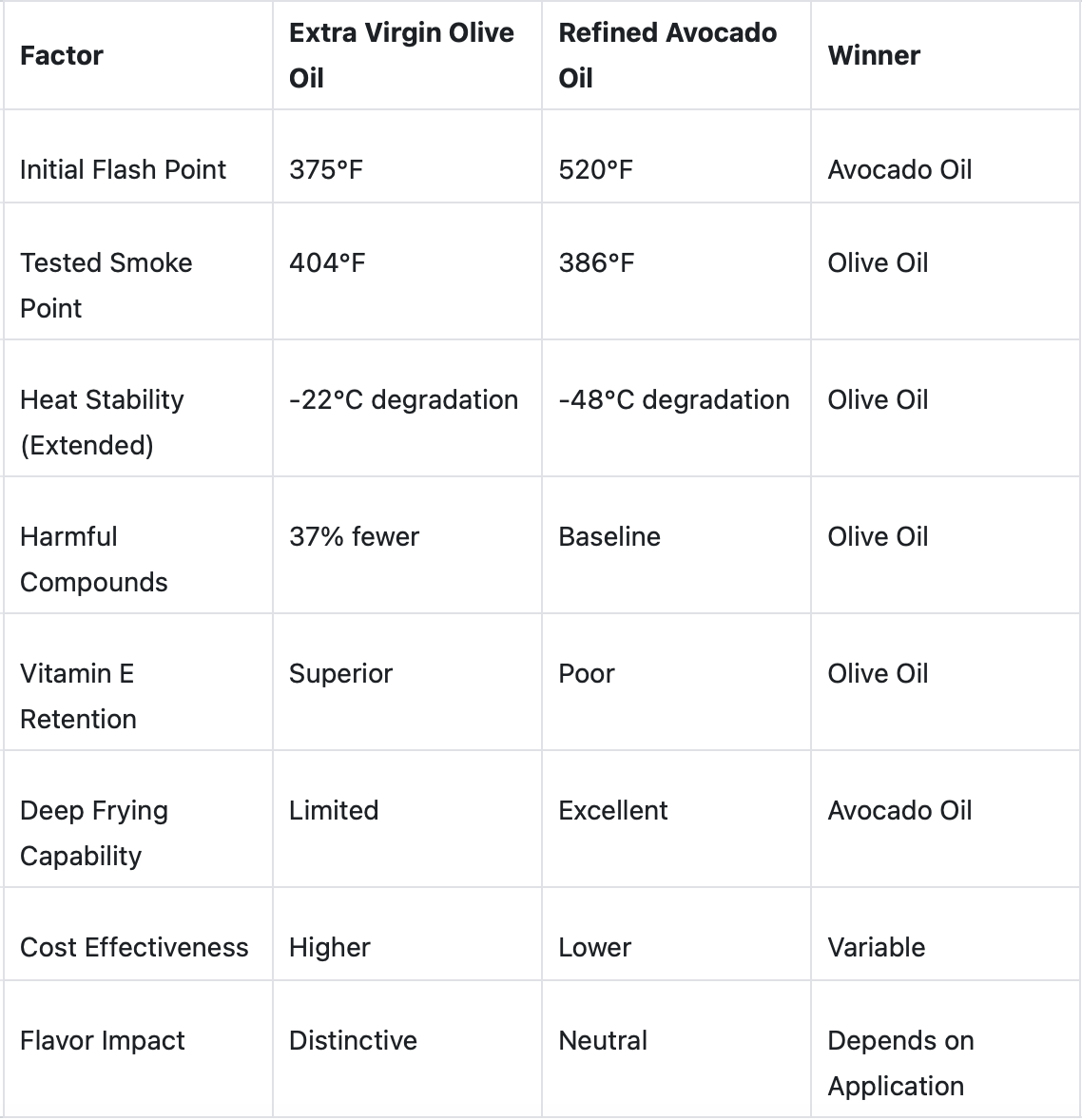
This comparison reveals why blanket recommendations about "best" cooking oils miss the mark. Each oil excels in specific applications, and the choice depends entirely on your cooking method and priorities.
Strategic Recommendations for Food Service Operations
Choose Extra Virgin Olive Oil for:
Sautéing vegetables and proteins (most common commercial application)
Roasting and baking applications under 400°F
Pan-frying where you want flavor development
Any application requiring sustained heat exposure
Operations prioritizing nutritional quality and antioxidant retention
Choose Refined Avocado Oil for:
Deep-frying operations requiring consistent high-heat performance
High-temperature searing (above 450°F)
Applications where neutral flavor is essential
Quick cooking methods with minimal heat exposure time
Avoid These Common Mistakes:
Using extra virgin avocado oil for high-heat cooking (poor cost-to-performance ratio)
Relying solely on smoke point numbers without considering heat stability
Ignoring oil quality variations that dramatically affect performance
Mixing oils without understanding their individual breakdown temperatures
World of Brio's Take on the Oil Selection Strategy
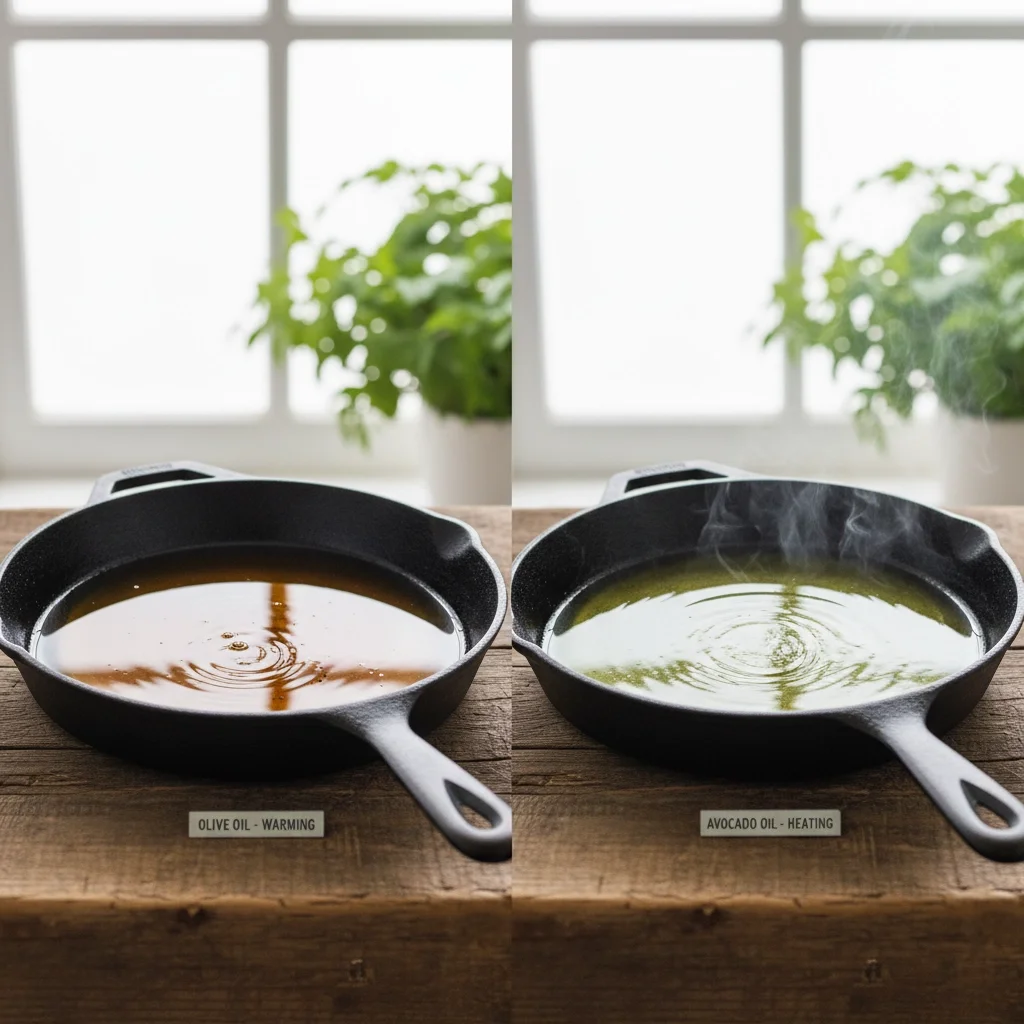
After working with hundreds of food service operations, we've observed that most kitchens benefit from a dual-oil strategy rather than trying to find one perfect solution. The data clearly shows that EVOO outperforms avocado oil in 80% of common commercial cooking applications, while avocado oil excels in the remaining 20% that require extreme temperatures.
Our recommendation: stock premium EVOO as your primary cooking oil for versatility and performance, then maintain refined avocado oil specifically for deep-frying and high-heat searing applications. This approach optimizes both cost efficiency and cooking performance across your entire operation.
The key insight from recent testing is that heat stability matters more than initial temperature tolerance for most cooking methods. While avocado oil's 520°F smoke point looks impressive on paper, EVOO's superior stability during actual cooking conditions makes it the more reliable choice for daily operations.
Quality sourcing remains critical regardless of your oil choice. Premium oils from established suppliers consistently outperform commodity alternatives, and the performance gap widens significantly under high-heat conditions. Investing in quality oil sourcing pays dividends in both cooking performance and final dish quality.
The flash point showdown between olive oil and avocado oil ultimately comes down to matching the right tool to the specific job. Understanding the science behind these oils' performance characteristics helps food service professionals make informed decisions that improve both kitchen efficiency and final product quality.
Like what you read? Here is the pdf for your records.